
A new McKinsey report by Matthias Kässer, Tobias Schneiderbauer and Henrik Becker delivers a sobering reality check for anyone tracking freight decarbonization in Europe: despite nine years of model launches and more than 45 zero-emission (ZE) truck models now on the market, new registrations of ZE trucks remained below 5 percent as of 2025.
That’s a striking gap between vehicle availability and actual uptake, and the costs of continued delay are rising, not falling.
Urgency
The urgency stems from three factors. Every ZE truck that replaces a diesel unit cuts roughly 60 to 80 tonnes of CO2 per year, so slow adoption means real, accumulating emissions costs. Second, European operators risk missing the cost-efficiency gains that come with scale. The kind that supports dedicated battery-cell production lines. Third, EU heavy-duty vehicle emission standards impose significant financial penalties on OEMs that fall short of regulatory targets, squeezing their room to invest and innovate. Meanwhile, Chinese manufacturers with cost and learning-curve advantages from scaling elsewhere are entering the European market and challenging incumbent OEMs on price.
Success factors
McKinsey identifies three interlocking success factors. On vehicles, the market has matured: electric trucks now offer ranges of 700–800 km, and hydrogen powertrains are emerging for long-haul, high-payload use cases.
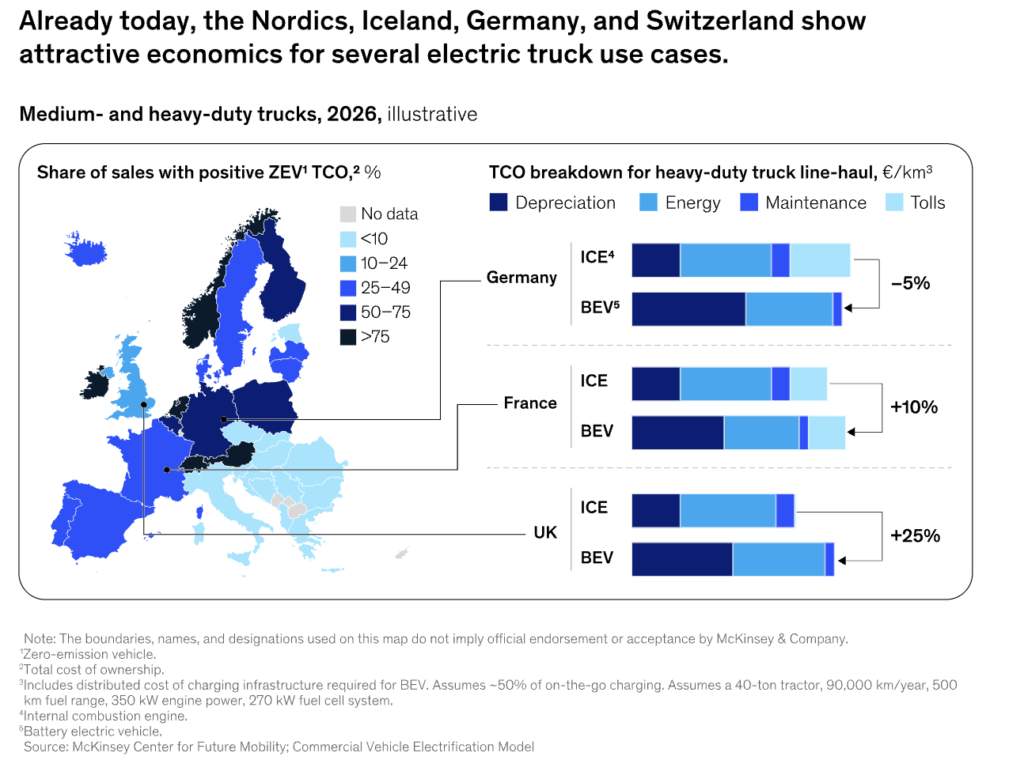
On economics, ZE trucks already offer a total-cost-of-ownership advantage for about 30 percent of the market, though that advantage is fragile) cross-border routes are especially vulnerable to differences in tolling, taxation, energy prices and charging tariffs. Notably, 60 percent of fleet operators surveyed said they’d switch at TCO parity, and 80 percent would switch if ZE trucks were 10 percent cheaper to run, suggesting the economic case, not operator reluctance, is the binding constraint.
Infrastructure is the sharpest bottleneck. Only around 2,000 public fast-charging points exist today for ZE trucks, against a requirement of 15,000–20,000 by 2030 and 40,000–50,000 by 2035; meaning today’s total needs to roughly double every year for five years running. Hydrogen refueling stations show a similar shortfall: fewer than 200 exist, compared with a regulatory requirement of around 700 by 2030.
Depot and fleet-hub charging needs are larger still (200,000 points by 2030), and total charging infrastructure investment through 2035 is estimated at more than €40 billion, before grid upgrades are even factored in. Grid access compounds the problem: in Germany alone, there are over 800 distribution system operators, with a median wait time of 120 days for grid connection, sometimes stretching to two years.
What needs to be done?
The report’s prescription is twofold: cut ZE truck upfront costs by 10–20 percent (which would make roughly half of annual EU truck sales TCO-competitive) and harmonize fuel costs and toll incentives across member states, especially for cross-border transport.
On infrastructure, it calls for proactive grid capacity planning, new financing models to limit fleet operators’ capital exposure, and demand-derisking mechanisms (such as offtake guarantees or regulatory backstops) to protect infrastructure investors against stranded assets. For city logistics operators closely watching the economics of electrification, the message is clear: vehicles are ready, but policy consistency and charging infrastructure remain the real constraints on scale.
Source: McKinsey